




Selecting the right outboard motor is one of the most critical—and expensive—decisions you will make when purchasing a pontoon or tritoon boat. Underpowering your boat leads to frustrating days on the water, sluggish acceleration with a full crew, and an inability to pull watersports. Conversely, paying for maximum horsepower you never actually tap into unnecessarily inflates your upfront investment, insurance premiums, and fuel consumption.
Outboard power options for modern pontoon boats range from modest 25 HP engines up to blistering 300 to 450+ HP beasts.
To determine the ideal horsepower for your setup, you must look past the spec sheet and evaluate four essential variables: boating activities, typical passenger weight, hull design, and lake conditions.
Here is everything you need to know to dial in the perfect horsepower rating for your lake life.
The 4 Factors That Dictate Your Pontoon Horsepower
Before looking at specific engine tiers, analyze how these four real-world elements influence your boat’s performance:
1. Hull Configuration (Two Tubes vs. Three Tubes)
Your boat’s hull type sets your operational baseline:
- Twin-Tube Pontoons: Standard two-log pontoons produce more hydrodynamic drag and lack the center buoyancy required for large engines. Most twin-tube hulls max out between 90 HP and 150 HP. Adding more power beyond 150 HP yields diminishing returns on top speed because the hull plows rather than planes.
- Tritoons (Triple-Tube Packages): Adding a center log, especially with lifting strakes and an aluminum underskin, lifts the hull out of the water. This platform demands more base power to plane effectively, typically starting at 150 HP and scaling up to 300+ HP.
2. Primary Boating Activities
What you plan to do behind and on the boat directly dictates engine torque:
- Casual Cruising & Sandbars: Requires minimal displacement to push water at comfortable 10–18 MPH speeds.
- Tubing & Watersports: Pulling adult wakeboarders, skiers, or multi-rider tubes requires immediate hole-shot torque to rip riders out of the water without bogging down.
3. Passenger Weight & Payload
A boat that feels snappy with two people at a dealership demo can feel completely bogged down when you load eight adults, two loaded coolers, safety gear, and a full tank of fuel. Every extra passenger adds roughly 150 to 200 lbs of drag. If you plan to host large crews, always step up one engine tier above the baseline.
4. Lake Size, Currents, & Wind Chop
- Small, Calm Lakes: Low-displacement engines work perfectly on private reservoirs or speed-restricted waters.
- Large, Busy Reservoirs: Navigating whitecap chop, strong river currents, or massive cruiser wakes requires reserve throttle response to maintain steerage and power safely through rolling waves.
PONTOON HORSEPOWER & PERFORMANCE SPECTRUM
┌──────────────┬──────────────┬──────────────┬────────────────────────────┐
│ HP Range │ Top Speed │ Hull Type │ Primary Application │
├──────────────┼──────────────┼──────────────┼────────────────────────────┤
│ 25 – 60 HP │ 10 – 17 MPH │ Twin-Tube │ Electric-only/small lakes │
│ 70 – 115 HP │ 18 – 26 MPH │ Twin-Tube │ Family cruising, angling │
│ 150 HP │ 28 – 35 MPH │ 2 or 3 Logs │ The multi-use “sweet spot” │
│ 200 – 250 HP │ 36 – 45 MPH │ Tritoon Only │ Serious watersports, speed │
│ 300+ HP │ 45 – 55+ MPH │ Perf. Tritoon│ Flagship big-water thrills │
└──────────────┴──────────────┴──────────────┴────────────────────────────┘
Horsepower Breakdown: Choosing Your Power Tier
25 HP to 60 HP: The Calm-Water & Fishing Cruiser
- Realistic Speeds: 10 to 17 MPH
- Best For: Small inland lakes (under 500 acres), speed-restricted waterways, and casual fishing crews.
- Pros: Highly economical upfront cost, sip-fuel efficiency, and light trailering weight.
- Cons: Cannot tow adult skiers or wakeboarders; struggles against strong headwinds or heavy currents.
70 HP to 115 HP: The Weekend Family All-Rounder
- Realistic Speeds: 18 to 26 MPH
- Best For: Families with a standard 18-to-22-foot twin-tube boat who want to cruise, swim, and pull young kids on single-rider tubes.
- Pros: Excellent balance between purchase price and everyday practicality. A 115 HP outboard (like a Yamaha F115) easily moves a fully loaded pontoon across mid-sized lakes without straining.
- Cons: Lacks the low-end torque required for deep-water adult slalom skiing or aggressive, high-speed watersports.
150 HP: The Versatility “Sweet Spot”
- Realistic Speeds: 28 to 35 MPH
- Best For: 20-to-24-foot boats (both high-end twin-tubes and entry tritoons).
- Why It’s the Industry Favorite: The 150 HP motor is widely considered the most versatile power plant on the market. It provides ample torque to pull adult wakeboarders and multi-rider tubes, powers through rough boat wakes with 8 to 10 adults on board, and retains solid resale value.
200 HP to 250 HP: High-Performance Tritoon Territory
- Realistic Speeds: 36 to 45 MPH
- Best For: 22-to-25-foot tritoons operating on massive, choppy lakes.
- Pros: Effortless hole-shots, rapid acceleration, and sports-car-like banked turns. You can carry a full boat of 12 passengers and coolers and still run 35+ MPH across open water without hesitation.
- Cons: Requires a heavy-duty transom, tandem-axle trailer, and a larger fuel budget.
300 HP to 425+ HP: Maximum Speed & Luxury Power
- Realistic Speeds: 45 to 55+ MPH
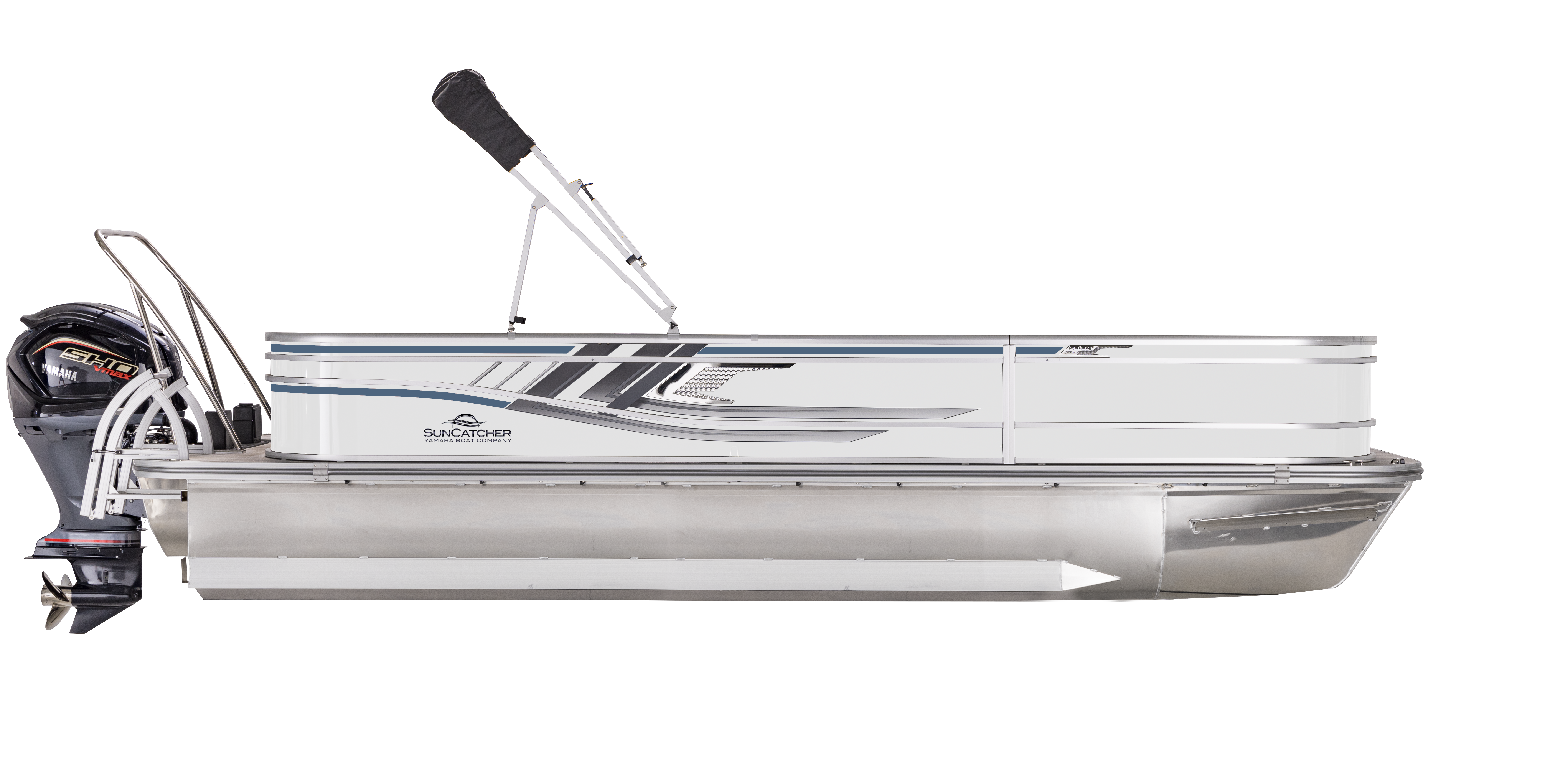
- Best For: 25-to-27+ foot luxury flagship tritoons (such as the SunCatcher Amara Series).
- Pros: Delivers supercar thrills, instant throttle response, and effortless cruising on rough coastal bays or giant reservoirs.
- Cons: High purchase price, premium fuel demands, and specialized maintenance requirements.
The Golden Rule of Pontoon Power
When budgeting for your pontoon, follow this golden rule: Buy the maximum horsepower your budget allows within 80% to 100% of the boat’s Coast Guard plate capacity.
Boaters rarely complain about having too much power, but many regret underpowering their vessel after their first windy weekend loaded down with guests. Choosing the right outboard ensures your pontoon stays nimble, safe, and fun for every season ahead.